
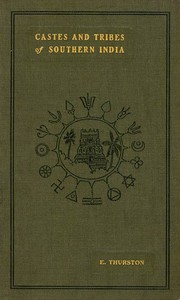
Castes and Tribes of Southern India. Vol. 3 of 7 by Edgar Thurston
Let's be clear from the start: this isn't a novel. 'Castes and Tribes of Southern India' is a seven-volume ethnographic survey, and Volume 3 is a deep slice of that project. Compiled by Edgar Thurston in the early 1900s, it was part of a British colonial effort to understand and categorize the immense social complexity of India.
The Story
There's no traditional plot. Instead, the book is organized like a reference guide. Thurston moves through an alphabetical list of communities, from the Ganigas (oil-pressers) to the Koyis (a tribal group). For each entry, he combines official census data with his own observations. You'll find notes on traditional occupations, descriptions of physical features (sometimes including body measurements), snippets of language, and accounts of social customs and rituals. It's a methodical, sometimes shockingly clinical, attempt to document human diversity on a grand scale.
Why You Should Read It
Reading this today is a unique experience. The value isn't just in the raw data—which historians and some communities still reference—but in seeing the mindset behind it. You're watching the birth of modern anthropology, with all its brilliant detail and its deep flaws. Thurston writes with the confidence of his era, blending science with the biases of colonial thought. It makes you think: How do we classify people? Who gets to do the classifying, and why? The book is a primary source that doesn't just tell you about Southern India in 1909; it shows you how a powerful administration tried to make sense of it.
Final Verdict
This is a specialist's book, but it has wider appeal for a very specific reader. It's perfect for history buffs, anthropology students, or anyone researching South Indian genealogy or social history. For the general curious reader, I'd recommend dipping into specific entries rather than reading cover-to-cover. Approach it as a historical artifact, not a definitive truth. You'll come away with a profound sense of how much has changed, and a clearer understanding of the complicated roots of how we talk about identity, community, and culture even now.
Anthony King
1 year agoI didn't expect much, but the pacing is just right, keeping you engaged. Truly inspiring.
Patricia Clark
8 months agoCompatible with my e-reader, thanks.
John Martin
2 months agoTo be perfectly clear, the author's voice is distinct and makes complex topics easy to digest. I couldn't put it down.






Christopher Torres
1 year agoI stumbled upon this title and it creates a vivid world that you simply do not want to leave. Worth every second.