
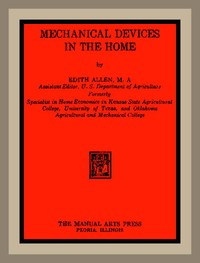
Mechanical Devices in the Home by Edith Allen
Published in 1918, Edith Allen's Mechanical Devices in the Home is exactly what the title promises: a practical guide. But its magic lies in the context. This isn't a modern DIY book. It's a snapshot of a home in transition, caught between the old ways and the new wave of electricity and modern conveniences. Allen systematically takes the reader through the inner workings of a early-20th-century house.
The Story
There isn't a plot in the traditional sense. Instead, Allen acts as a tour guide for your own home. She starts with the fundamentals—plumbing, heating, and ventilation—explaining how water gets to your tap and how coal furnaces work. Then, she moves room-by-room: the kitchen (with deep dives into iceboxes and early gas stoves), the laundry, the bathroom. The final sections feel the most futuristic, covering basic electrical wiring for doorbells, lights, and telephones. Each device is broken down with clear diagrams and explanations of its mechanical principles, assuming no prior knowledge. The 'story' is the journey of a home from a manually-operated shell to a machine for living.
Why You Should Read It
I picked this up out of sheer curiosity and couldn't put it down. Allen's voice is patient and precise, but there's a palpable sense of excitement about this new, easier way of living. Reading her describe the process of installing an electric light—from the wiring to the switch to the bulb—you feel the wonder she must have felt. It completely reframed how I see my own home. That humble toilet? A marvel of hydraulic engineering. The thermostat? A genius regulator. It makes you appreciate the absolute army of inventors and engineers whose work is hidden in your walls. It’s also a powerful reminder of how much physical work running a home used to require, work that largely fell to women like Allen.
Final Verdict
This book is a hidden gem for a specific reader. It's perfect for history buffs, old-house owners, or anyone with a soft spot for how things work. If you love YouTube channels about restoration or vintage technology, you'll adore this primary source. It's not a page-turning thriller, but a slow, satisfying read that turns your everyday surroundings into a museum of innovation. Just be warned: you might finish it and immediately start inspecting your door hinges.





David Perez
1 year agoI was skeptical at first, but the arguments are well-supported by credible references. Highly recommended.